The Devil Wears Prada: A Culinary Critique of Ambition

The Devil Wears Prada begins with a montage of women preparing for work.
They select their clothes carefully. They apply makeup. They coordinate underwear, shoes, bags, and accessories. Their movements are meticulous because appearance is part of the professional language of their industry.
Then there is Andy Sachs.
Andy throws on whatever is available, grabs an onion bagel, and arrives at one of the most influential fashion magazines in the world without knowing anything about fashion, Runway, or Miranda Priestly.
The film wants us to understand that Andy is different. She is intelligent, practical, and unconcerned with something as superficial as clothing.
There is another interpretation.
Everyone else prepared for work.
Andy did not.
She applied for a highly competitive position in an industry she had not bothered to research. She does not know who Miranda is. She cannot identify important designers. She later asks how to spell Gabbana.
Andy is not merely badly dressed.
She is incompetent.
That creates the central contradiction of The Devil Wears Prada. The story carefully shows Andy becoming more capable, disciplined, confident, and professionally fluent. The moral framing then insists that this growth represents corruption.
The result is a film with excellent structure, perfect movement, brilliant individual details, and almost no satisfying payoff.
But before we begin, here's a brief reminder of what DigitalCyn’s Salsa Analysis framework is.
The Salsa Analysis Framework
Have you ever experienced a story—a novel, film, audiobook, television series, or video game—and thought:
The characters are wonderful, but something is missing.
Or perhaps the world is detailed and fascinating, but you have absolutely no idea where the story is going.
Or the plot is exciting, but you do not care what happens to anyone in it.
I've been writing books for over - you don't need to know my age - and I've learned that a story has more ingredients than just the characters or their journey.
I call this the Salsa Analysis framework.

First, every story needs a good tomato base.
The tomato is the structure: the plot, pacing, causality, progression, and the form in which the story is being told.
This is the spine of the story.
Then we add a little oil, which is the smoothness, meaning how easily the audience can move through the story.
The audience should not work to understand your story; it should come easy, frictionless.
But a smooth story and a detailed world are still not enough.
We need onion.
Onion is emotional depth.
What does the character want? What do they fear? What do they love? What are they unwilling to admit?
Most importantly, what do they choose?
An emotional reaction may last for one scene. An emotional consequence changes what the character does afterward.
And when the onion is especially effective, it makes the audience cry.
Then we add parsley.
Parsley represents detail and care: world-building, consistency, foreshadowing, recurring ideas, character-specific behaviour, and all the small choices that tell the audience that someone cared while constructing this story.
A detail should not exist merely because it is clever.
It should reveal a character, establish a rule, create contrast, foreshadow something, return later, or change the meaning of another scene.
Parsley keeps the world alive beyond the immediate needs of the plot.
Next, we ask: What narrative risks am I taking?
What gives this story an identity that could not easily be confused with another?
That is the garlic.
Garlic is boldness, voice, originality, and commitment. But boldness should not be confused with spice.
Spice is tension, danger, uncertainty, and stakes.
What could the character lose?
What would failure cost them?
And are those consequences meaningful to the character, or are they only enormous on paper?
The goal is not maximum danger. The goal is meaningful tension.
Finally, none of these ingredients can succeed without salt.
Salt is the payoff.
What promise did the story make?
Was that promise fulfilled?
Did the ending merely stop the action, or did it make something click into place?
If it did, then you might have found the perfect salsa.
Let us examine the recipe for The Devil Wears Prada.
Tomato: Structure
The tomato provides the body of the salsa, and structurally, The Devil Wears Prada is excellent.
Andy’s professional development happens through a clear escalation of challenges.
First, she must bring coffee correctly and on time.
Then she must learn Miranda’s schedule, language, preferences, and expectations.
Then she is trusted with the Book.
Then she must obtain the impossible Harry Potter manuscript.
Then she enters Miranda’s personal world through her daughters.
Then she manages the gala.
Finally, she is selected for Paris and exposed to the political machinery that protects Miranda’s position.
Each assignment represents a new level of trust.
Andy’s first real job is not answering phones or collecting scarves. Her first job is proving that she can be trusted with the actual job.
Emily establishes the environment immediately. She has no time to babysit someone who arrived unprepared. Nigel explains the culture. Miranda tests Andy’s resilience. Christian introduces an alternative professional network. Paris represents Andy’s full entry into the industry.
The progression is carefully designed.
Even the makeover is structurally meaningful. It is not simply a transformation from unattractive woman to attractive woman. Anne Hathaway was already gorgeous, despite the film’s repeated insistence that she was somehow fat.
The clothing represents professional fluency.
Andy learns to speak the language of the workplace.
Her posture changes. Her timing improves. She anticipates Miranda’s needs. She becomes more confident. She stops waiting for everyone to explain what she should already know.
The clothes are not the transformation.
They make the transformation visible.
The tomato is firm, well prepared, and holding the entire recipe together.
🍅🍅🍅🍅🍅
Oil: Smoothness
The oil is perfect.
The film moves effortlessly.
Miranda’s introduction is one of the best character entrances in cinema because her authority is established before she appears. The office transforms at the news of her arrival. Shoes are changed. Makeup is applied. Desks are cleared. Employees run through the building.
Miranda does not have to announce that she matters.
Everyone else’s behaviour announces it for her.
The dialogue is fast without becoming exhausting. The montages communicate professional development without requiring lengthy explanations. Scenes transition naturally from comedy to pressure, from public performance to private vulnerability.
Nigel carries exposition without sounding like an exposition machine because his personality is inseparable from the information he provides.
Emily creates movement simply by entering a scene. Her urgency gives the office rhythm.
Miranda can control a room with a glance.
Even when the emotional logic is weak, the movie rarely feels slow.
The meeting room scene is a perfect example. The audience may not understand every name, designer, layout, or decision being discussed, but the dialogue remains entertaining because competence itself becomes pleasurable to watch.
Nigel knows the answers.
Miranda knows exactly what she wants.
Andy slowly learns how to keep up.
The movie also understands when silence is more effective than dialogue. Miranda watching Andy on the stairs with her daughters communicates a shift in trust. Miranda’s bag landing on Emily’s desk tells us that Andy has replaced her before anyone explains it. Miranda’s final hidden smile says more than another speech could have said.
The film is polished, controlled, and extremely easy to watch.
🧈🧈🧈🧈🧈
(Bear with me, there is no oil emoji, so butter)
Onion: Emotional Depth
Miranda is the onion, and I know exactly how that sounds, but hear me out: Almost all the genuine emotional depth belongs to her.
At first, Miranda appears to be an unstoppable force. She is demanding, observant, emotionally inaccessible, and accustomed to immediate obedience.
What a terrifying Dragon-Lady!
Then the hotel scene reveals the person inside the position.
Her marriage is ending. Her private pain is about to become public entertainment. She worries about the effect on her daughters more than the humiliation to herself.
Miranda has feelings?
OMG, she does! She simply does not have many tools for expressing them.
So when Andy asks whether she can do anything, Miranda replies:
“Your job.”
Which is perfect.
Miranda does not need Andy to become her therapist. She needs her assistant to preserve the structure that allows her to continue functioning.
The moment also reveals the real cost of Miranda’s success.
This is not one missed birthday dinner or an irritated boyfriend. Miranda’s marriage is collapsing. Her vulnerability could threaten her authority. Her personal grief must be processed according to a professional schedule.
She has achieved extraordinary influence, but that influence has not protected her relationships.
That is emotional consequence.
Andy’s supposed emotional losses are much less convincing.
Her personal life is allegedly “hanging by a thread,” but the film does not properly build that deterioration. Shortly before she makes this claim, she and Nate appear affectionate and intimate.
Then she misses his birthday.
That may hurt him, but one missed birthday does not automatically prove that Andy has sacrificed her soul to capitalism.
The film wants the audience to feel that Andy’s career is destroying her relationships, but it relies on declarations rather than development.
Nate says she has changed.
Her friends say she has changed.
Andy says she has changed.
The story rarely shows enough to justify the moral weight attached to those accusations.
Emily has greater emotional potential, but the film mainly uses her for comedy and tragedy. Her devotion to Paris, her hunger, illness, exhaustion, and eventual accident could have explored the cruelty of an industry that demands everything from its workers.
Instead, her suffering largely clears the path for Andy.
Nigel’s lost promotion should be devastating. He has dedicated his life to the industry and finally receives the opportunity to build something of his own. Miranda sacrifices that future to preserve Runway and her position.
Yet the movie moves away from his pain quickly because the event primarily exists to awaken Andy morally.
The onion is strong whenever Miranda is involved.
The rest remains underdeveloped.
🧅🧅🧅
Garlic: Boldness and Identity
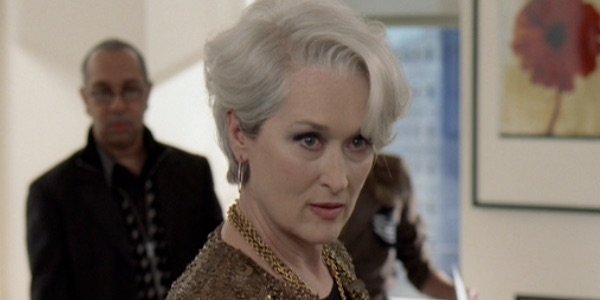
This film looks bold.
It sounds bold.
It has one of the most recognizable visual identities of its era, particularly because, even 20 years later, there aren’t too many strong career-driven female characters in film like Miranda Priestly.
But when the time comes to defend its own ideas, it loses confidence.
The cerulean speech should be the film’s thesis.
Andy laughs because two belts appear identical to her. Miranda traces the colour of Andy’s sweater from designer collections to department stores and discount bins.
Andy believes she exists outside fashion.
Miranda explains that fashion has already shaped her choices.
This is not merely a speech about clothes. It is a defence of craft, expertise, art, commerce, and invisible labour.
Artists throughout history have had to defend why their work matters.
People understand that Banksy’s graffiti may contain political meaning because the message is visibly placed on a wall. People accept that a banana taped to a wall can provoke debates about art, value, institutions, and attention.
Why can a cerulean belt not participate in the same conversation?
Fashion contains history, economics, politics, gender, class, labour, identity, and control over the body.
Why are functional pockets so often missing from women’s clothing?
That absence is connected to design traditions, silhouettes, commercial decisions, gender expectations, and assumptions about how women should carry their belongings.
A dress is not automatically a political statement, but fashion does not exist outside politics.
It is a skill.
It is a discipline.
Wedding photographers are told that they “just press a button.”
Designers supposedly “just choose clothes.”
The easier skilled work appears, the easier it becomes to pretend that no skill was required.
Andy looks at an entire discipline and sees capitalism.
Miranda sees culture.
The film briefly makes this argument brilliantly.
Then it abandons it.
Andy’s friends continue treating fashion as ridiculous while happily accepting expensive products from the industry.
Nate treats Andy’s improved clothes as evidence that she has lost her integrity.
Christian treats Runway as an embarrassing interruption before Andy begins a serious career in journalism.
The ending returns Andy to the supposedly respectable world of newspapers, restoring the division between meaningful intellectual work and shallow fashion work.
The film creates a bold identity and then becomes embarrassed by it.
It defends fashion in its most famous scene while allowing almost every supposedly morally trustworthy character to continue dismissing fashion.
That is weak garlic.
🧄🧄
Parsley: Detail and Care
There are excellent details throughout the film.
The problem is that many of them are wasted.
Miranda hires Andy after Andy finally defends herself. That tells us Miranda respects conviction and intelligence.
It is so entertaining to see them tango about competency, and so rewarding to see Andy rise to the challenge. Even when she fails, because Andy fails a lot, Miranda knows exactly what to tell her to push her forward, even if that is calling her “the smart, fat girl.”
I believe it is brilliant how Andy’s ego takes a shot every time, but instead of bringing her down, she wants to do better because at the end of the day, despite Andy’s constant complaints… she wants Miranda’s approval.
No wonder Gen X thinks we millennials need participation trophies.
Anyway, the film could have used this to build a deeper professional relationship between them.
Instead, it mostly uses Miranda’s interest in Andy to create increasingly difficult tasks.
The moment on the stairs with Miranda’s daughters is beautiful because it's literally spelling it out for Andy that Miranda is more than a workaholic tyrant.
And if you pay really close attention, you can see it when Miranda then gives Andy the impossible Harry Potter assignment.
To the audience, Miranda later telling the girls that “Mommy is working very hard” may sound petty, as though she is stealing Andy’s achievement.
But Andy is Miranda’s assistant. Miranda uses her assistants as extensions of her responsibilities. Entrusting Andy with something for her daughters is not merely another act of cruelty. It is an opportunity to enter Miranda’s private machinery.
That detail could have transformed the audience’s understanding of the assistant relationship.
But the film does not explore it enough.
Then Emily’s response to Andy’s gala outfit is another wasted detail. Emily was never simply against Andy. She had no time to train someone who refused to take the job seriously. And let’s be honest, no one likes to be stuck babysitting the newest hire, which is why once Andy becomes competent, Emily recognizes it.
The film could have developed a more complicated relationship between them, built on rivalry, respect, resentment, and shared pressure.
Instead, Emily becomes the person Andy must displace so the film can accuse Andy of becoming Miranda.
And they set the bar so low for Andy to rise above Emily. It only took for Emily to forget the name of the Ambassador approaching Miranda.
I am not saying that Miranda had low standards, but that is what the film is communicating with the sequence.
Now, Christian’s respect for Andy’s writing is useful because it reminds us that Andy has ambitions beyond Runway.
But the film does not do enough with her writing.
We are repeatedly told she is a talented journalist. We rarely see her journalistic intelligence operating inside the story.
Why does working at Runway not sharpen her observational skills?
Why does she not become curious about the economics, labour, politics, influence, or personalities of fashion?
Why does she never consider writing about the world she has learned to understand?
The film has already built the bridge between fashion and journalism.
Andy refuses to cross it, and the script never seems to notice the lost opportunity.
Even the detail of Andy’s father giving her money for rent undermines the supposed stakes of the job.
The film tells us that Andy needs employment to pay the bills, but it then gives her a financial support system.
She is not counting coins in her purse.
She is not facing eviction.
She does not appear trapped by debt, medical expenses, immigration status, dependants, or any other serious financial pressure.
No, she goes to a restaurant to toast with her friends: “To jobs that pay the rent.”
Then her father gives her money.
Her boyfriend works.
She has friends.
She has education and professional options.
Andy can leave.
That makes the repeated claim that she has “no choice” even weaker, particularly because she only defends the position once to her father even though she is repeatedly reminded that “A million girls would kill for this job.”
There is enormous care in individual scenes, gestures, costumes, and performances.
The problem is that the screenplay often fails to use those details in service of its final argument.
Beautiful parsley, scattered over the wrong meal.
🌿🌿
Spice: Excitement and Tension
The film has urgency.
It does not have strong stakes.
Those are different ingredients.
Emily runs.
Phones ring.
Miranda makes impossible demands.
Cars must arrive immediately.
Booking last-minute flights.
Coffee must remain hot.
The Book must be delivered.
The manuscript must be obtained.
Paris is approaching.
All of this creates speed.
But what happens if Andy quits?
The film never establishes a convincing answer.
At the beginning, Andy frames Runway as one of the jobs that pays the rent. That could have created pressure. She might have needed to tolerate an unfamiliar and hostile environment because she had no financial alternative.
But the film does not support that premise.
Her father can help her financially.
Andy has an education.
She has a boyfriend and a social network.
She is not presented as desperate.
She does not even respect the opportunity enough to research it before the interview.
The Harry Potter manuscript is treated like a crisis, but Andy can resign.
The gala is treated like a crisis, but the personal consequences of failure remain vague.
Paris is supposedly the opportunity of a lifetime, but Andy spent much of the film claiming she did not want a career in fashion.
Her relationship with Nate is supposedly collapsing, but their conflict is built through sudden accusations rather than cumulative damage.
The investor plot creates genuine professional stakes for Miranda.
She could lose control of the magazine she built.
Hundreds of careers may be affected.
Her reputation, authority, and future are threatened.
That is real Spice.
But those stakes belong to Miranda, not Andy.
Andy’s central tension should have been internal:
She has discovered that she enjoys being good at this work.
She respects Miranda more than she admits.
She likes being chosen.
She values the access, confidence, and influence the role provides.
She also sees the emotional and ethical cost of pursuing success without limits.
That could have created powerful tension.
Instead, the film repeatedly substitutes accusations of corruption for genuine conflict.
The pacing is spicy.
The stakes are mild.
🌶️🌶️
Salt: Payoff
The ending does not complete Andy’s arc.
It abandons it.
Andy throws Miranda’s phone into a fountain and walks away.
The moment is framed as liberation, but it resembles her established pattern of retreat.
When the Harry Potter assignment appears impossible, she wants to quit.
When Nate confronts her, she ends the relationship rather than properly articulate what she wants.
When she sees Miranda make a morally complicated business decision, she abandons the job without a conversation.
Andy cannot tolerate failure, ambiguity, or accountability.
Her favourite explanation is that she had no choice.
She needed the job.
Miranda chose her for Paris.
Emily’s accident made the decision unavoidable.
The industry changed her.
Her relationship simply fell apart.
But Andy repeatedly makes choices.
She wants the manuscript victory.
She enjoys becoming competent.
She wants Miranda’s approval.
She wants Paris.
She wants to be taken seriously by Christian.
She enjoys her new confidence.
None of those desires makes her a bad person.
Her failure is refusing to admit that she desired them.
Miranda exposes this when she says that Andy already did to Emily what Miranda did to Nigel.
It is only a half-truth.
Andy did not plot against Emily. Andy’s performance made her the stronger choice, and Miranda made the business decision.
But Andy did want the reward.
She wants to consider herself completely innocent because she did not personally announce the decision.
Miranda recognizes that competence has consequences.
Andy wants competence without responsibility.
A satisfying ending would have required Andy to own her choices.
She could have told Miranda:
I understand why you made that decision. I understand what this career could offer me. I also understand that I do not want to build my life according to the same priorities.
Then she could have resigned professionally.
That would have represented growth.
She would have taken Miranda’s standards, Nigel’s understanding of craft, Emily’s commitment, and her own developing confidence into the next stage of her life.
Instead, she throws away the phone.
Then she apologizes to Nate, and the film appears to validate his belief that ambition, fashion, and professional transformation had corrupted her.
The movie restores Andy’s moral purity by returning her to people who never respected her professional growth.
Miranda, ironically, behaves more generously.
She gives Andy an exceptional recommendation.
She does not sabotage her.
She helps her obtain another position.
When she sees Andy on the street, she smiles privately.
Miranda is not angry because Andy refused to become her.
She is disappointed because Andy possessed enormous potential and lacked the vision to use it.
That is also my final judgment of Andy.
Disappointment.
Wasted opportunity.
The salt is missing.
🧂
Final Score
| Ingredient | Score |
|---|---|
| Tomato: Structure | 5/5 |
| Oil: Smoothness | 5/5 |
| Onion: Emotional Depth | 3/5 |
| Garlic: Boldness and Identity | 2/5 |
| Parsley: Detail and Care | 2/5 |
| Spice: Excitement and Tension | 2/5 |
| Salt: Payoff | 1/5 |
| Total | 20/35 |

Final Verdict
The Devil Wears Prada is a perfectly plated film with a confused recipe.
Its structure is excellent.
Its pacing is flawless.
Its performances are memorable.
Its details are intelligent.
Miranda is one of cinema’s great characters because she is competent, passionate, vulnerable, ruthless, observant, and human.
The film also produces one of the strongest defences of fashion ever placed in a mainstream movie.
Then it loses faith in its own argument.
It treats Andy’s professional growth as moral deterioration. It manufactures relationship conflict without establishing strong emotional stakes. It gives Andy opportunities, support, talent, and access, but allows her to pretend that she never made a choice.
Fashion is not “just clothes.”
The cerulean belt is art, labour, history, commerce, politics, and communication.
Andy’s tragedy is not that she entered that world.
It is that she finally learned how much it contained and still walked away without truly understanding what she had been given.
That makes Andy the most irrelevant character in the story, because if you remove Andy from the equation, Miranda would still make the final business decision and take Nigel’s overdue dream position away. Instead of putting that decision in Andy’s hands and having her confront Miranda face to face, the film has her cowardly quit. I mean, not even two weeks’ notice? Didn’t she need the job for her rent? For her important journalist career?
I thought you would be different. I thought, go ahead, take a chance, hire the smart, fat girl.
Miranda saw Andy’s potential from the beginning…
By the end, Andy had become capable of almost anything.
Then she threw it into a fountain.
As a woman in the business world - yes, I too have a day job that pays the bills - what is the lesson for me? Don't be like Miranda? Don't be successful?
And the biggest misconception we all have when we look at success is thinking it's free.
It’s not. It costs you your time and energy, and, for Miranda, her marriage.
.pptx.jpg)

Comments
Post a Comment
Add your ingredient breakdown or suggest the next film or book. Disagreement is welcome; personal attacks and promotional spam are not.